Selfish Mining Blocks
Visualizes both Monero and Qubic branches, showing where their blocks collided or diverged.
In late 2025, we began noticing many orphaned blocks appearing on the Monero blockchain. These orphans weren’t random. They seemed to coincide with mining activity coming from Qubic, a project that connects external miners through job notifications.
When Qubic miners worked on Monero, their private blocks often conflicted with honest miners. This led to repeated short forks, visible as parallel block runs on our visualizer. At the same time, Qubic claimed very high hashrates (OVER 51%) that didn’t match what the Monero network actually accepted. Qubic suggested that they were mining aggressively, but not always successfully.
In simple terms, Monero was being “challenged” by Qubic miners.
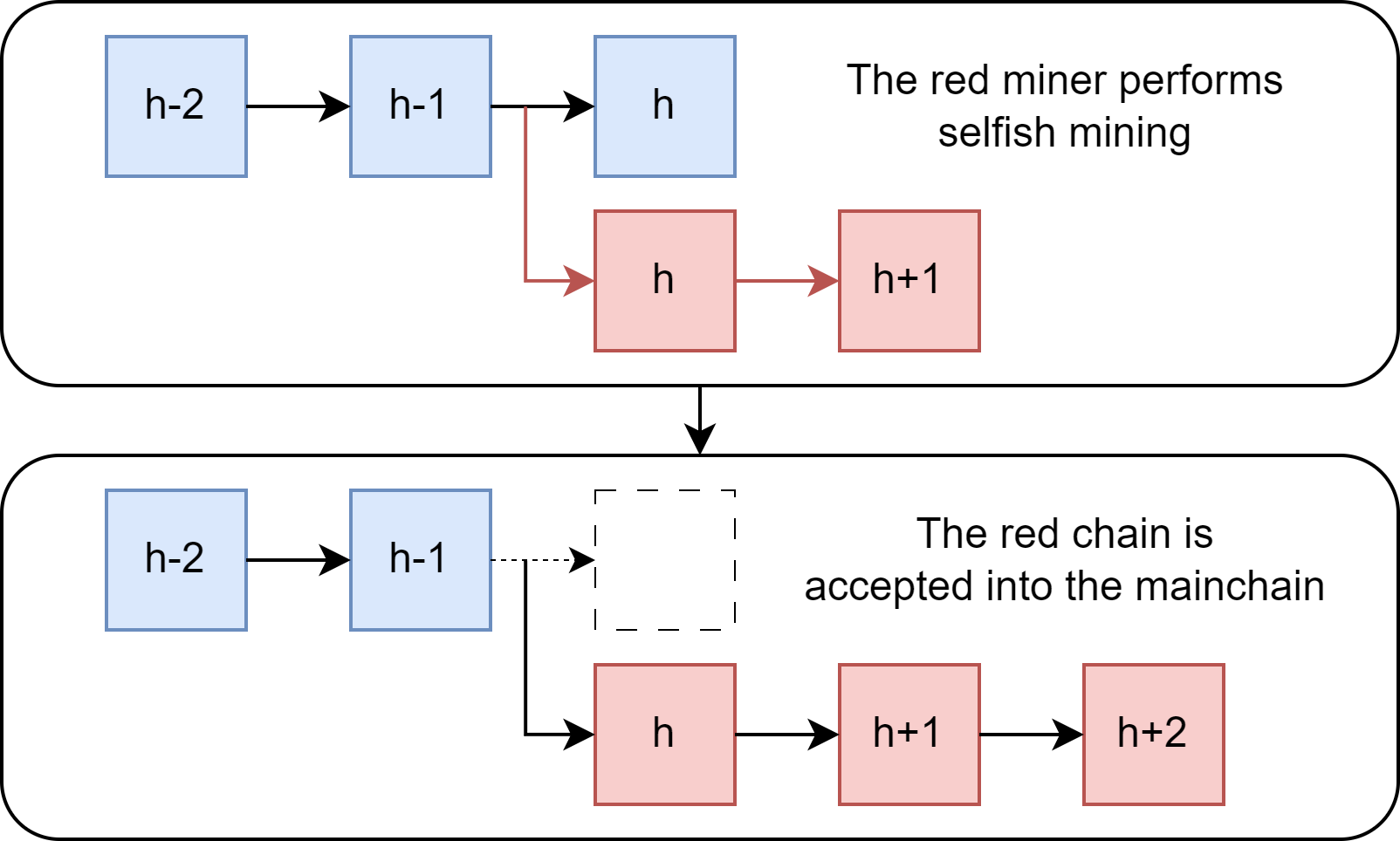
Selfish mining is a strategy where miners don’t immediately share the blocks they find. Instead, they keep their own private chain and release it at just the right moment to outpace everyone else.
Normally, when a miner finds a block, they broadcast it to the whole network right away. In selfish mining, the miner keeps it secret, continues building on it privately, and reveals it later, trying to make the public chain’s newest blocks invalid. If their chain turns out longer, the network accepts theirs and discards the honest blocks.
To figure out which blocks belonged to Qubic, we looked at patterns in the coinbase
transactions. Every mined block has a coinbase, a unique fingerprint of who mined it.
Inside that data, there’s a field called extra_nonce.
We found that Qubic miners used a distinct format in their extra_nonce values,
which became our main heuristic to tag their blocks.
Using this pattern, we labeled Qubic-attributed blocks in real time.
Our server continuously queries a local monerod node via RPC to fetch fresh
block data, applies the heuristic, and then overlays Qubic-attributed blocks on
Monero’s canonical timeline so you can see where they overlap, compete, or fork away.
If you’re curious about the math behind it, you can read our paper for the full model.
Visualizes both Monero and Qubic branches, showing where their blocks collided or diverged.
Shows live Qubic job notifications and how they align with Monero block heights.
Lists canonical Monero blocks and identifies orphans during Qubic’s activity windows.
Aggregates how many Qubic-attributed blocks appeared in each time period.
Shows how often Monero’s blocks were replaced or orphaned during Qubic’s attacks.